An adult beginner should start with the basic 8-beat rock groove, then move on to simple bass drum variations, four on the floor, and the half-time beat, before tackling the 16-beat. Learning them in that order builds a steady pulse and independence between the hands and feet, which every later groove depends on. This 16-beat drum guide explains each step, what to listen for, and how to practise without frustration.
Many adults sit down at a kit wanting to play a favourite song straight away. That instinct is a good one, because almost every song is built from a small family of beats. Studio 72 is a music school in Singapore that teaches only adults, and its lessons focus on the songs students actually want to play rather than a graded exam syllabus.
What 8 Beat and 16 Beat Mean on the Drum Kit
Drummers often name a groove by how many hi-hat notes are played in one bar of 4/4 time. An 8-beat groove has eight evenly spaced hi-hat notes in the bar, counted 1 and 2 and 3 and 4 and. A 16-beat groove has sixteen hi-hat notes in the bar, counted 1 e and a 2 e and a 3 e and a 4 e and a.
This is the idea behind most guides to 16-beat drum patterns, and it is why the 16-beat comes after the 8-beat. The hands have to move twice as fast at the same tempo, so a sixteenth note groove is far easier once the simpler pulse feels automatic. A metronome and a slow tempo are the most reliable tools for getting there.
Why the Order of Beats Matters for Adult Learners
Adults usually bring a clear head and strong motivation to the kit, but also busy schedules and limited practice time. A sensible order of beats avoids wasted effort, because each new beat adds exactly one skill to the one before it. Skipping ahead tends to produce tense shoulders and a rushing tempo, which are harder to undo than to avoid.
Each step below should feel comfortable at a slow tempo, around 60 to 80 beats per minute, before you move on. Comfortable means you can play the pattern for two minutes without speeding up or stopping, while counting aloud. If you cannot do that yet, stay with the beat you are on.
The Beats to Learn First, in Order
Step 1: The Basic 8 Beat Rock Groove
This is the beat behind more songs than any other. The hi-hat plays steady eighth notes, the bass drum lands on counts 1 and 3, and the snare drum lands on counts 2 and 4. Say the count aloud as you play: 1 and 2 and 3 and 4 and.
Keep the hi-hat hand perfectly even before you worry about the feet. Most beginners find it easier to practise hands only first, then add the bass drum, then add the snare. Once all three move together at a slow tempo, the beat is ready for the next step.
Step 2: Bass Drum Variations
When the basic groove is steady, move the bass drum to new positions while the hi-hat and snare stay the same. A common first change is adding a second bass drum note on the and after count 3, so the bass drum plays on count 1, count 3, and that extra and. Each variation teaches your foot to move independently of your hands, which is the central skill in drumming.
Three or four variations are enough at this stage. Together with the basic groove, they cover a large range of pop and rock songs. If you would like a teacher to check your posture and grip while you build them, one-to-one drum lessons in Singapore are available for adults.
Step 3: Four on the Floor
Four on the floor means the bass drum plays on every count, 1 2 3 4, while the snare stays on 2 and 4 and the hi-hat keeps its eighth notes. It is the foundation of disco, dance music and a great deal of modern pop. Because the foot plays more often, it builds steadiness and stamina in the leg.
A popular variation is to open the hi-hat slightly on each and between the counts, which gives the classic disco lift. Keep the tempo slow so the open and closed sounds stay clean and even.
Step 4: The Half-Time Beat
In a half-time beat, the snare moves from counts 2 and 4 to count 3 only. The hi-hat continues in eighth notes and the bass drum plays on count 1, so the song feels as if it has slowed down even though the hi-hat has not changed.
It is a good lesson in patience, because there is more space in the bar and every note has to land exactly in time. Many adults also find it a satisfying first taste of playing with feel instead of simply playing the notes. It also sounds especially good when several drummers play together, which is one reason group drum lessons for adults in Singapore run in small classes of up to three students on electronic drum kits at the Boat Quay studio.
Step 5: The 16 Beat Groove
Only now does the 16 beat make sense. The hi-hat plays sixteenth notes, four to every count, while the bass drum and snare use the same placements you already know. Counted aloud, it sounds like 1 e and a 2 e and a 3 e and a 4 e and a.
Play it much slower than the 8-beat at first, often around 50 to 60 beats per minute. Use alternating hands, right-left-right-left, so the sixteenth notes stay even, and keep the hi-hat quiet so the snare stands out. A useful bridge is the 8-beat with a few sixteenth-note bass drum patterns, which lets the feet get used to the faster subdivision before the hands do.
Practice Tip: Set a Metronome and Count Aloud
A metronome makes a drifting tempo obvious, and counting aloud keeps your attention on where each note belongs. Set it to a speed where you can play the beat perfectly, then raise it by two or three beats per minute only when it feels easy. This slow, patient approach is the difference between a beat that survives under pressure and one that falls apart the moment you speed up.
The Five Beats at a Glance
Here is the whole progression in one place. Each beat keeps the earlier skills and adds one new idea.
- The basic 8-beat rock groove: hi-hat on every eighth note, bass drum on 1 and 3, snare on 2 and 4
- Bass drum variations: the same hands, with the bass drum moved to new counts
- Four on the floor: bass drum on every count, snare on 2 and 4
- The half-time beat: snare on count 3 only, bass drum on count 1
- The 16-beat groove: sixteenth-note hi-hat with the bass drum and snare ideas you already know
After these five, a shuffle, a slow ballad groove, and a reggae one drop are natural next steps. They use the same coordination in a different rhythmic feel.
Common Mistakes Adults Make With Drum Beats
Rushing and Tension
The most common problem is speeding up as a beat gets easier, usually together with raised shoulders and a tight grip. Both feed each other, because a faster tempo creates tension and tension makes the playing less accurate. Loosen the grip so the stick can rebound off the drum, and let the metronome set the pace.
If you notice yourself speeding up, stop, take a breath, and restart at a slower tempo. Short, calm repetitions build better habits than long, tense ones.
Skipping the Count
Many beginners try to feel the beat without counting it, and the beat then drifts the moment a foot or hand changes. Counting aloud ties each note to its place in the bar and makes mistakes easy to spot. You can stop counting once the beat is fully automatic, but not before.
How to Practise Beats Between Lessons
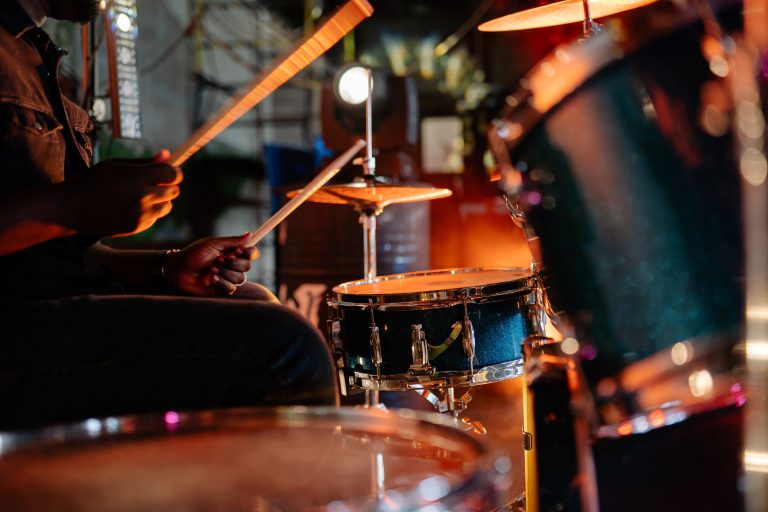
Regular, short practice builds coordination faster than occasional long sessions. A practice pad and a metronome are enough for hand work, and you can rehearse the bass drum patterns by tapping your foot while counting aloud. Even fifteen focused minutes a day gives each new beat time to settle. Our guide to practising drums at home in Singapore without a full kit explains quiet ways to keep progressing in an apartment.
Record yourself on a phone every week or two and listen back for a drifting tempo. Hearing the playback often shows problems that are invisible while you are playing.
Learning Beats Through Songs, Not Exams
Adults learn fastest when practice has a clear purpose. At Studio 72, there are no graded exams and no practice diaries to hand in, so lessons stay focused on the songs you want to play. Most students begin with no prior musical experience, so beginners are the norm rather than the exception.
Playing next to other musicians makes steady time feel more natural, because you hear the pulse in the room as well as in your own sticks. Organised performances and jam sessions are part of the culture at Studio 72, so there is a place to use your beats once they are ready.
From Steady Grooves to Playing With Others
Once these five beats feel natural, a wide range of songs opens up, from slow ballads to upbeat rock. The same beats remain at the centre as you add fills, accents and new rhythmic feels.
If you would like to try a kit before committing, get in touch with Studio 72 to ask about a trial. Individual lessons begin with a free trial, so there is no obligation to find out whether drumming suits you.
Frequently Asked Questions
What drum beat should a beginner learn first?
A beginner should learn the basic 8-beat rock groove first, with the hi-hat on every eighth note, the bass drum on counts 1 and 3, and the snare on counts 2 and 4. It is the foundation of most pop and rock songs. Practise it slowly while counting aloud before adding any variations.
What is a 16 beat on drums?
A 16 beat is a drum groove in which the hi-hat plays sixteen evenly spaced notes in each bar of 4/4, four notes to every count. It is counted 1 e and a 2 e and a 3 e and a 4 e and a. Most beginners learn it after the 8 beat, because the hands must move twice as fast at the same tempo.
How many drum beats should an adult beginner learn?
Five core beats are enough for an adult beginner: the 8-beat rock groove, bass drum variations, four on the floor, the half-time beat, and the 16-beat. Together, they cover a very large share of pop and rock songs. More beats can be added once these feel steady and relaxed.
How slowly should I practise a new drum beat?
Most beginners should practise a new beat at around 60 to 80 beats per minute, and slower still for the 16-beat. The right speed is the one where you can play the pattern evenly for two minutes while counting aloud. Raise the metronome only when the beat feels easy.
Can an adult learn drums with no musical experience?
Yes, an adult can learn drums with no musical experience, because drumming starts with pulse, counting, and coordination rather than reading music. Most of Studio 72’s students begin with no prior musical experience. Steady, short practice matters more than any natural talent.
Do I need a full drum kit at home to learn these beats?
No, you can learn the first beats on a practice pad and a metronome, because the skills involved are timing and coordination. A pad covers the hands, and tapping your foot while counting rehearses the bass drum. A full kit becomes useful later, when you want to put the limbs together.
Does Studio 72 teach drums to adults only?
Yes, Studio 72 is a music school exclusively for adults and does not offer children’s classes. Drum lessons are available one-to-one or in small groups at its Boat Quay studio in Singapore. Individual lessons begin with a free trial.