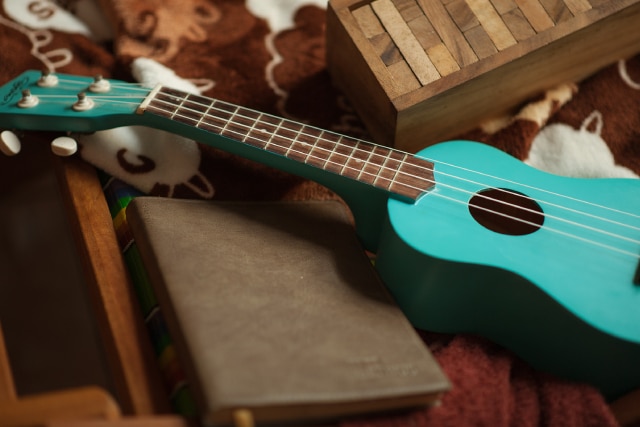
The first ukulele chords an adult beginner should learn are C, A minor, F, and G7, because together they unlock the four-chord progression behind a huge number of popular songs. Each shape needs only one to three fingers, which keeps the early weeks manageable for adult hands. This guide to ukulele chords for beginners shows the finger positions, the order to learn them in, and how to practise the changes between them.
Studio 72 is a music school in Singapore that teaches adults only, so the advice here is written for grown-up learners who want to play real songs without sitting graded exams. Whether you are picking up an instrument for the first time or returning to music after years away, these four shapes are a sensible place to start.
Before You Learn a Chord: Know Your Ukulele
Ukuleles come in four common sizes: soprano, concert, tenor, and baritone. Soprano, concert, and tenor ukuleles share the same standard tuning, so the chord shapes in this guide work on all three. Baritone ukuleles are tuned differently, so the same shapes will sound wrong on one.
The four strings, from the one nearest your face to the one nearest the floor, are G, C, E, and A. Chord diagrams show the strings in that same order from left to right, with the headstock at the top. Tune before every practice session with a clip-on tuner or a phone app, because new nylon strings stretch and drift out of tune quickly. If you are unsure which size suits your hands, Studio 72’s ukulele lessons for adults in Singapore are a good place to ask.
How to Read the Numbers in This Guide
Frets are counted from the headstock end of the neck, so the first fret is the one closest to the tuning pegs. Fingers are numbered 1 for the index finger, 2 for the middle finger, 3 for the ring finger, and 4 for the little finger. An open string is one you play without pressing any fret.
The First Four Ukulele Chords for Adults
These four chords are ordered from the easiest to the hardest. Learn them one at a time, and move to the next only when the current shape rings out clearly on every string.
C Major, the One Finger Chord
C major needs only your ring finger, pressing the A string at the third fret. The other three strings stay open. Strum slowly and check that each string sounds clearly, with no buzzing or muted notes.
A Minor, Also One Finger
A minor uses your middle finger on the G string at the second fret, while the other three strings stay open. Because only one finger moves between them, C major and A minor make a good pair for your first chord changes. Their shapes are small, which suits adults who are still building finger strength.
F Major
F major uses two fingers: your index finger on the E string at the first fret and your middle finger on the G string at the second fret. The C and A strings stay open. Keep your fingertips upright so they do not touch and mute the open strings beside them.
G7
G7 uses three fingers: your index finger on the E string at the first fret, your middle finger on the C string at the second fret, and your ring finger on the A string at the second fret. The G string stays open. The three fingertips form a small triangle, which many adults find easier to remember than to describe.
The Four Chords at a Glance
Here is a quick reference for the four shapes, in the order to learn them. Each line gives the finger, the string, and the fret.
- C major: ring finger on the A string, third fret
- A minor: middle finger on the G string, second fret
- F major: index finger on the E string at the first fret, middle finger on the G string at the second fret
- G7: index finger on the E string at the first fret, middle finger on the C string at the second fret, ring finger on the A string at the second fret
Played in the order C, A minor, F, and G7, these chords make a four-chord loop that fits a great many pop songs. A steady strum of one downstroke per count is enough to start with.
Why These Four Chords Come First
In the key of C, C is the home chord, F and G7 are the chords most closely related to it, and A minor is its relative minor. That means a single set of four fingerings can accompany a large number of songs without changing key. It also means you meet real songs early, which keeps motivation high.
For an adult learner, that early payoff matters more than a perfect syllabus. Studio 72 teaches ukulele one-to-one at its Boat Quay studio, with no graded exams and no fixed syllabus, so the first chords you learn are the ones your first songs need. Many ukulele players later add a second instrument, and guitar lessons in Singapore for adults cover acoustic and electric guitar at the same studio.
Chords to Add Next
Once the four shapes are comfortable, three easy additions are C7, A7, and D7. C7 is played with just your index finger on the A string at the first fret, and A7 with your index finger on the C string at the first fret. D7 uses your index finger on the G string and your middle finger on the E string, both at the second fret.
D minor is the next shape worth learning after those. It needs three fingers: your middle finger on the G string at the second fret, your ring finger on the C string at the second fret, and your index finger on the E string at the first fret. The A string stays open.
How to Practise Chord Changes as an Adult
Short Sessions Beat Long Ones
Ten to fifteen focused minutes a day usually works better than one long session at the weekend. Fingertips need time to toughen, and muscle memory forms between sessions rather than during them. Some soreness in the fingertips is normal in the first couple of weeks, but stop if you feel pain in your hand or wrist.
The One Minute Change Drill
Pick two chords, such as C major and A minor, and count how many clean changes you can make in one minute, strumming once per change. Write the number down and try to beat it next time. Move on to a new pair only when the changes feel automatic.
A Simple Strumming Pattern to Pair With It
Start with one downstroke per count, saying 1 2 3 4 aloud. When that is steady, try down, down, up, up, down, up, a pattern used in many ukulele songs. Keep your wrist loose and let your fingers brush across the strings rather than pluck them. Many adults also like to sing along while they strum, and vocal lessons for adults in Singapore are taught at the same studio.
Common Mistakes Adults Make With First Chords
The most common problem is pressing too hard. A light, precise touch just behind the fret wire sounds cleaner than a tight squeeze, and it saves your hand from tiring quickly. If a string buzzes, move your fingertip closer to the fret wire before adding any pressure.
Another frequent mistake is letting a fingertip flatten against a neighbouring string, which mutes it. Curve your fingers so the tips come down on the strings from above. Check each string one at a time, then strum the full chord again.
Many beginners also skip tuning, which makes even correct chords sound wrong and quietly discourages practice. Tuning takes less than a minute and is worth doing every time.
Learning Alone or With a Teacher
Learning from videos works well for some adults, but nobody is watching your fretting hand. A teacher can spot a buzzing string, a collapsed fingertip, or tension in the wrist straight away. At Studio 72, individual lessons begin with a free trial, so you can try a first lesson with no obligation.
Picking Your First Song to Play

When the four chords feel steady, choose one simple song that uses only those shapes and learn it slowly from start to finish. A song with a clear, repeating chord pattern gives you a reason to practise changes in context. Play along with the original recording once you can keep time without it.
If you would like a teacher alongside you for that first song, get in touch with Studio 72 to ask about a trial lesson. There is no need to wait until you feel ready, because most students begin with no prior musical experience.
Frequently Asked Questions
What are the easiest ukulele chords for beginners?
The easiest ukulele chords for beginners are C major and A minor, because each needs only one finger. F major and G7 follow, using two and three fingers. Together, these four chords cover a large number of simple songs.
How many ukulele chords should a beginner learn first?
A beginner should learn four chords first: C major, A minor, F major, and G7. They fit together in the key of C and form a common four-chord loop. More chords can be added once the changes between these four feel smooth.
What tuning do the chord shapes in this guide use?
The chord shapes in this guide use standard G, C, E, A tuning on soprano, concert, and tenor ukuleles. Baritone ukuleles are tuned differently, so these shapes will not sound right on one. Always tune before you practise.
How long should an adult practise ukulele each day?
Ten to fifteen minutes a day is a sensible target for an adult beginner. Short, regular sessions build muscle memory and let fingertips toughen gradually. Stop and rest if you feel pain in your hand or wrist.
Is the ukulele easier to learn than the guitar for adults?
The ukulele is often easier for adults to start with, because it has four strings, a shorter neck, and softer nylon strings. Chord shapes need fewer fingers, so first songs arrive sooner. Both instruments still need regular practice to sound good.
Do I need to read music to learn ukulele chords?
No, you do not need to read music to learn ukulele chords, because chord diagrams show exactly where each finger goes. Most beginners learn from diagrams and by ear. Studio 72’s lessons are built around the songs you want to play, not an exam syllabus.
Does Studio 72 teach ukulele to adults?
Yes, Studio 72 teaches ukulele one-to-one to adults at its Boat Quay studio in Singapore. It is a music school exclusively for adults and does not offer children’s classes. Individual lessons begin with a free trial.