
Choosing your first instrument as an adult can be surprisingly difficult. You may love the sound of guitar but find yourself drawn to the bass lines in your favourite songs. If you are exploring your options, music lessons in Singapore for adults can give you a starting point for understanding what is available.
Bass and guitar may look similar, but they play different roles in music. Guitar can provide chords, melody, and rhythm, while bass focuses more on groove, timing, and the musical foundation of a song. The better choice is not necessarily the easier instrument. It is the one that suits how you want to play.
Bass vs Guitar: What Is the Difference?
Guitar is a versatile instrument. It can provide chords behind a singer, play riffs and melodies, or take the lead with a solo. Because it can combine harmony and rhythm, guitar is particularly useful if you want to play songs on your own.
Bass usually sits in the lower register and works closely with the drums to establish a song’s groove. Bassists generally play individual notes rather than full chords, helping connect the rhythm section with the song’s harmony.
These roles shape the way each instrument is learnt. Guitar beginners often spend time developing chord shapes, strumming and picking, while bass beginners tend to focus more on individual notes, timing and listening.
Six Differences Beginners Should Consider
1. Technique
Guitar involves learning chord shapes and moving between them smoothly. Bass generally uses individual notes, but its thicker strings and longer neck create different physical demands.
2. Rhythm
Timing matters on both instruments, but it is especially important for bass. A bassist needs to stay in time with the drummer and understand how their notes contribute to the groove.
Guitarists also need strong rhythm skills, particularly when strumming or playing with others, but they may spend more time exploring chords and melodies.
3. Playing alone
Guitar has an advantage if you want to accompany yourself. A few chords can be enough to support your singing or create a recognisable version of a song.
Bass can be practised independently, including with backing tracks, but its role often becomes clearer when played alongside drums and other instruments.
4. Playing with others
Bass is closely connected to ensemble playing. The bassist works with the drummer while supporting the harmony created by the rest of the band.
Guitar is equally useful in a group, but its role can vary from rhythm chords and riffs to melodies and solos.
5. Physical feel
Bass strings are generally thicker, with a longer neck and more space between notes. Guitar strings are thinner, and the neck is usually shorter.
Comfort is personal, so hand size should not be the only deciding factor. Good posture and technique also make a difference.
6. Musical style
Think about the music you already enjoy. Guitar is widely used in pop, rock, blues, acoustic, and singer-songwriter music. Bass is central to the groove and harmonic foundation of styles such as funk, rock, pop, R&B, and jazz.
Listen to a few favourite tracks with the specific aim of hearing the guitar and bass parts. You may quickly discover which one interests you more.
Is Bass Easier to Learn Than Guitar?
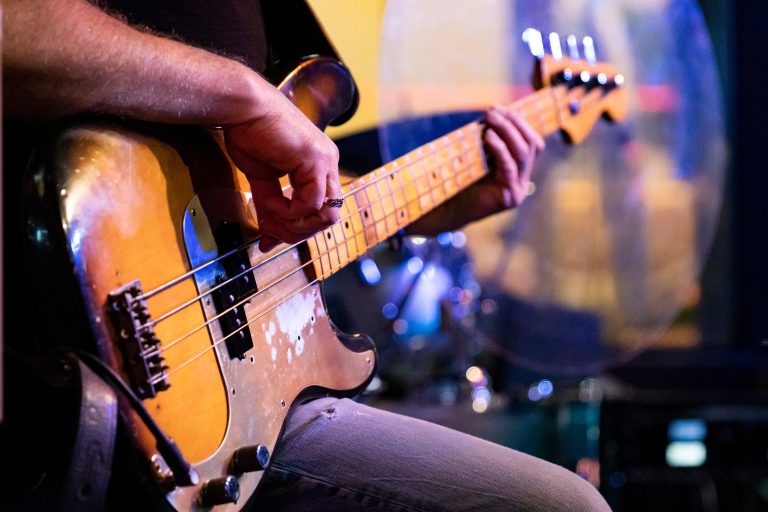
Bass can feel simpler at first because beginners often play individual notes rather than forming guitar chords. However, thicker strings, accurate timing, and playing consistently with a drummer all require practice.
Guitar can feel more demanding initially because chord shapes, chord changes, strumming, and picking take coordination. At the same time, learning a few basic chords can let a beginner play familiar songs relatively quickly.
Rather than choosing based on which instrument is supposedly easier, consider which type of playing you find more enjoyable. Interest is likely to keep you practising for longer.
Which Should an Adult Beginner Choose?
Think about what you would like to be doing with the instrument in six months.
If you picture yourself singing while playing, learning chords or playing songs independently, guitar may be the more natural choice. If you are more interested in groove, rhythm, bass lines, and playing as part of a band, bass may be a better fit.
There is no permanent commitment involved, either. Guitarists can learn bass later, and bassists can move to guitar. Some fundamentals carry across, although each instrument still requires its own practice.
If you remain undecided, trying both can tell you more than another comparison article. Notice which instrument feels comfortable, which sound you enjoy, and which one makes you want to pick it up again.
Learning Bass or Guitar as an Adult in Singapore

Once you have a better idea of what you want to learn, consider how you would like to approach it.
For adults balancing music with work and other commitments, a learning routine needs to be realistic. Think about what you want to play, how often you can practise, and the type of guidance you would find useful.
If bass appeals to you, you can explore bass guitar lessons for adults. If guitar feels like the better fit, guitar lessons for adults may be worth exploring.
Conclusion
For an adult beginner, the choice between bass vs guitar comes down to how you want to make music. Guitar offers versatility for chords, singing and independent playing, while bass centres on groove, timing and working with other musicians.
Neither is the universally better first instrument. Choose the one that matches your musical interests and makes you want to practise. If you are still unsure, you can get in touch with our team to discuss your options or try both before deciding where to start.
Frequently Asked Questions
Is bass easier to learn than guitar?
Bass can feel more straightforward initially because beginners often play individual notes rather than full guitar chords. However, timing and technique still take practice.
Should I learn bass or guitar first?
Guitar may suit you if you want to sing, play chords, and perform songs independently. Bass may be a better fit if you are drawn to groove, rhythm, and playing with other musicians.
Is it too late to learn bass or guitar as an adult?
No. Adults can start either instrument from scratch. Regular practice and realistic goals matter more than when you start.
Can I switch from guitar to bass later?
Yes. Some fundamentals transfer between the instruments, although each has different techniques and musical roles.
Can I learn both instruments?
You can, but concentrating on one instrument at first may make it easier to establish good technique and a regular practice routine. You can always add the other later.
Do bass and guitar lessons for adults follow the same structure?
Not exactly. At Studio 72, both bass and guitar lessons for adults are one-to-one, adult-only, and based around learning songs rather than following a fixed graded syllabus. Guitar lessons focus more on chord shapes, while bass lessons place greater emphasis on rhythm, timing, and groove.